eRank Keyword Tool vs TEOM Keyword Research: Same Keyword, Two Answers
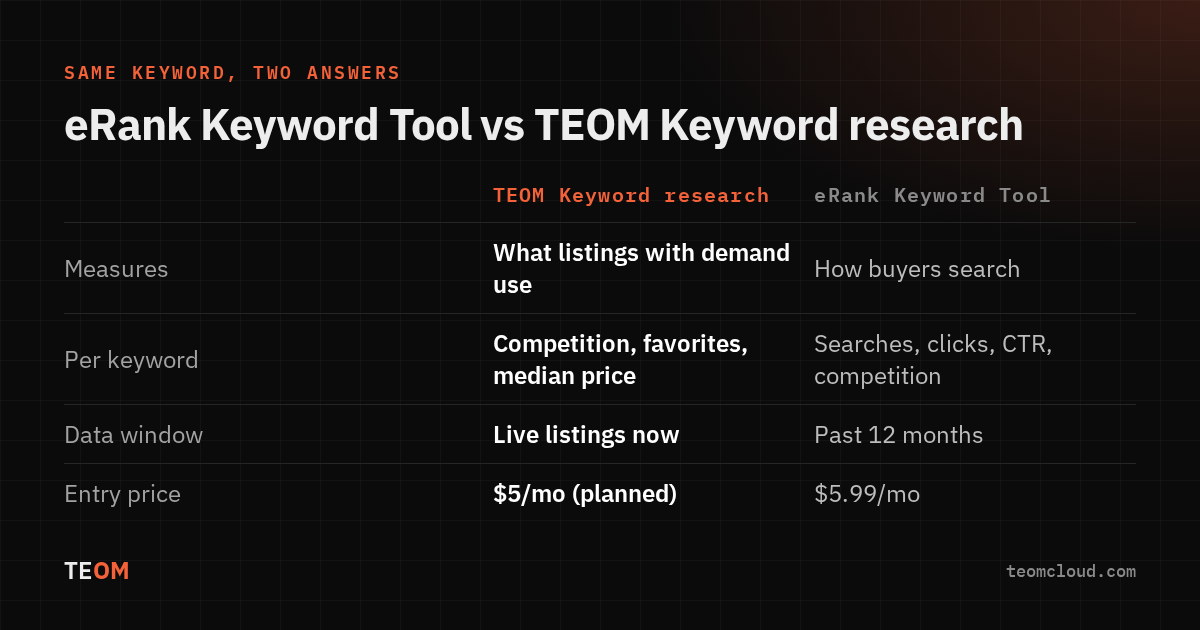
Type "junk journal" into two keyword tools and you get two different kinds of answer. Neither is wrong. They're measuring different things, and knowing the difference saves you from picking tags that look busy but don't sell.
The eRank Keyword Tool tells you how buyers search: average monthly Etsy searches, average clicks, click-through rate and seller competition for a term, based on the past 12 months. TEOM's Keyword research tells you what sells: it samples live listings for your seed term and ranks the tags and title phrases used by listings with real demand, with competition, average favorites and median price for each.
Here's how to use both answers.
Answer one: how buyers search (eRank)
eRank's help center describes its core metrics like this:
- Average Searches: average monthly Etsy shopper searches for the keyword.
- Average Clicks: average monthly clicks on listings in those searches.
- Average CTR: clicks divided by searches.
- Etsy Seller Competition: how many listings you're up against.
That's the right data for one specific question: is anyone typing this? If a phrase gets no searches, no tag trick will save it.
Do this today: for your main product, write down three phrases a buyer would type. Check that each one has real search activity before it earns a tag slot.
Answer two: what sells (TEOM)
TEOM comes at the same keyword from the sales side.
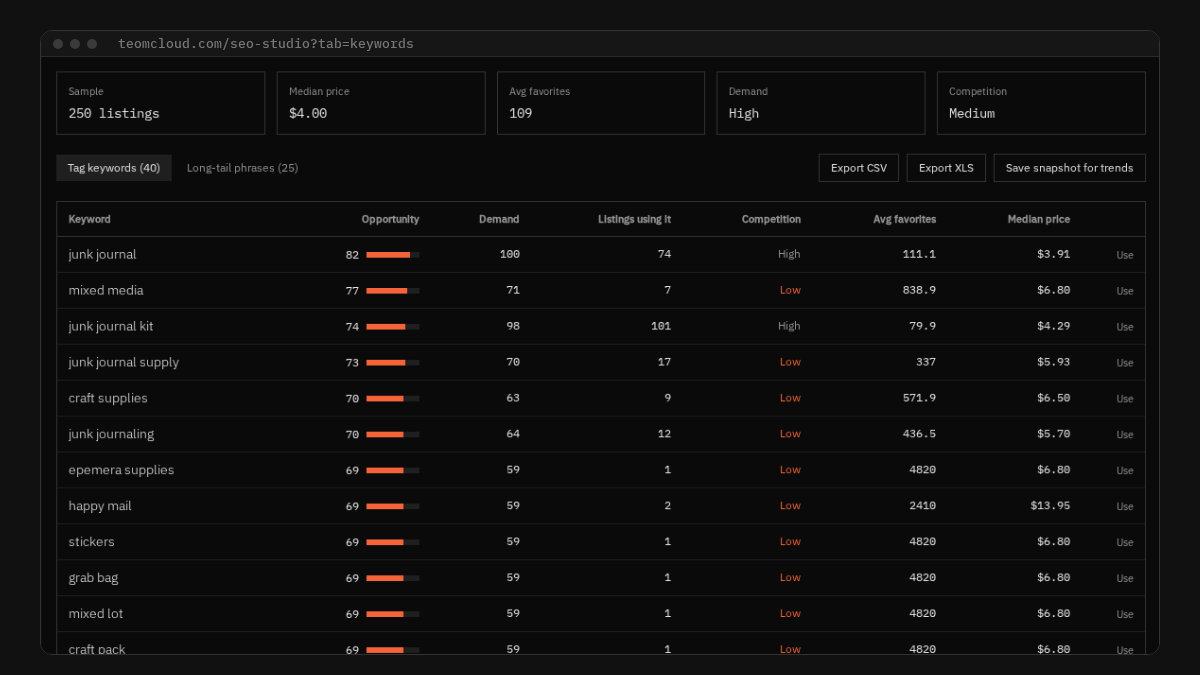
In TEOM: for each tag you see an opportunity score, a demand score, how many listings in the sample use it, competition, average favorites and median price, and a "Use" button that adds it to the tags in your Listing SEO audit.
On this sample, "junk journal kit" is used by 101 listings with high competition and a $4.29 median price. "junk journal supply" is used by 17 listings, low competition, an average of 337 favorites and a $5.93 median. Same niche, very different fight.
Search data can't show you that second row. It's not about how often a phrase is typed, it's about how much room there is for you once buyers click.
Why you want both answers
Picture the four possible combinations:
| Buyers search it? | Listings using it sell? | What to do |
|---|---|---|
| Yes | Yes, few sellers | Target it first |
| Yes | Yes, crowded | Use it, but compete on photos and price |
| Yes | No | Be careful: browsers, not buyers |
| No | Yes | A long-tail tag, cheap to add |
A keyword tool alone sees the first column. A market tool alone sees the second. Together they place every tag in the right box.
The cost of each answer
| eRank Keyword Tool | TEOM Keyword research | |
|---|---|---|
| Free | 5 keyword lookups/day | Part of 10 searches/day |
| Entry plan | 100 lookups/day, $5.99/month | Part of 100 searches/day, $5/month |
| Next plan | 200 lookups/day, $9.99/month | Part of 250 searches/day, $9/month |
| Data basis | Past 12 months of Etsy searches | Live listings right now |
TEOM is free during early access; the plans apply once paid plans launch.
In TEOM: press "Save snapshot for trends" after a keyword research, repeat it weekly, and the Trends tab charts how the market's estimated sales, favorites and median price move.
A tag workflow that uses both
- Brainstorm 20 phrases a buyer might type.
- Check search activity in a keyword tool and drop the dead ones.
- Run TEOM Keyword research on your main term and mark tags with demand, low competition and a median price near yours.
- Fill all 13 tags, mixing two big terms with eleven specific ones.
- Score the listing in TEOM Listing SEO before you publish.
Do this today: run step 3 on one product and swap your weakest two tags for the two best "low competition" tags you find.
FAQ
What does the eRank Keyword Tool show?
Average monthly Etsy searches, average clicks, click-through rate and seller competition for a keyword, based on the past 12 months of data.
Does TEOM show Etsy search volume?
No. TEOM measures the market side: which tags the listings with demand use, how crowded each tag is, average favorites and median price. Use a keyword tool for search volume.
Which keyword tool is cheaper?
TEOM's planned plans are $5 a month (100 searches a day) and $9 a month (250 a day), against eRank's $5.99 and $9.99. The two count usage differently, so compare against how many lookups you really run.